Get on your soap box...
 This is a little
corner of Agilitynet where you can speak freely on any agility subject whatsoever as long as it
is honest, decent and respectful. So gather round, express your ideas on any agility-related
topic, listen to the arguments and give us your feedback. If you have a burning issue or want
to respond to someone's comments below, email Agilitynet at ellen.rocco@agilitynet.co.uk
This is a little
corner of Agilitynet where you can speak freely on any agility subject whatsoever as long as it
is honest, decent and respectful. So gather round, express your ideas on any agility-related
topic, listen to the arguments and give us your feedback. If you have a burning issue or want
to respond to someone's comments below, email Agilitynet at ellen.rocco@agilitynet.co.uk
Having a Thoughtful Moment
From Julie Smith on FB
Thinking about what someone on Facebook was going through after loosing her old boy yesterday and how, upon reading the posts, so many hearts sank at the thought of it. We all know it could happen to any of us.
We hear so many people moaning and groaning and sniping at each other on forums etc. Doesn't the last day or so remind us that at the end of the day we are just one big family of dog lovers who in the hour of need would do anything in our power to help another dog lover no matter who they are. We are a blessed bunch of people who know what the unconditional love of our dogs mean. Let's try to be nicer to each other, people and remember the good things about being in this family.
A Reminder to Wake Up, the Autumn is Approaching
From Richard Partridge
We have all been enjoying the Summer, and what a glorious season this has been.
I’m sorry to have to remind you but the shorter days are coming, but this means a whole batch of new shows. I know from experience that entering shows is not something we tend to do in the Summer Agility season, we are all much too busy competing in those we booked up in the Spring. But the shows are there, the closing dates are looming and Show Secretaries are worrying over low entries.
So please, get on line, print the forms from Agilitynet or enter on-line, and while you are entering don’t forget to enter Weald Show at Golden Cross, 13 October. Closing date 10th September.
From Hannah Grantham
Strap those puppies down...


Boobs, baps, puppies, breasts! I have probably woken up half the male population with those four words and quite a few of you are now sniggering and giggling in the corner. Call them what you like, it’s a fact of life all women have them.
So what has this got to do with agility?I have recently noticed an increase in women running in the agility ring without the correct support, and by support I mean your bra ladies - or the lack of in some cases. Being an owner of a pair of 38Fs, I am well aware of the issues of running without good boob support and, before the majority of the male population start to offer their boob support services to us women, there are plenty of options in the guise of sports bras!
Think about it. How much time and money have you invested in getting the correct footwear for agility? I myself am a proud owner of the Inov8 Mudclaw Trail Running shoes that set me back £60 and that was in the sales! Then compare this to what you have invested in supporting your vital assets? My guess is that the running shoes came out tops!
Don’t get me wrong, the correct footwear in agility is vital to our health and performance. But Ladies, so is a good sports bra. Research shows that wearing a well-made, correctly fitted sports bra during any exercise can improve your performance and more importantly prevent any problems with you back, shoulders and breasts in the future.
Now I have the your attention, the men you can leave now This is the important bit that does not apply to you unless you own a large pair of moobs! What are the health risks of not wearing a sports bra?
What
your breasts are made of?
They are mainly tissue, mammary glands and muscle. The muscle is so deep it does not offer much
support to your breasts. It's the ligaments that do all the supporting. These ligaments are
called the ‘Coopers Ligaments’, these are thin bands that are interwoven into the breast
tissue, and are not very strong.
Because you boobs are not naturally supported, your breasts can move up, down, left, right, round and round, up to 10 or more centimetres in either direction during exercise. Ouch! This applies an enormous amount of pressure to the Coopers Ligaments and the breasts as a whole, so what can this lead to?
Saggy Boob Syndrome (SBS)
Yes, there really is a syndrome with this name. Do I hear sniggering again! The fact is with all that jiggling and bouncing during exercise, your Coopers Ligaments will stretch beyond repair, which results in less support of your boobs and you end up with saggy breasts. Oh! and before the less endowed women amongst us say ‘this does not apply to me’…… sorry ladies it does! No matter what size your breasticles are, SBS is a real risk to us all. None of us want to be like ‘Grandma Klump’ out of ‘The Nutty Professor 2’, in her words ‘I felt a pain in my chest, I looked down and I was stood on my titties…. with both feet!’.Tension and Strains
Larger breasted ladies, listen up! I fall into this category; carrying around larger boobs every day makes the muscles in the upper back, shoulders and neck work a lot harder. Most of us are fine with this on a daily basis and a normal well fitted bra is sufficient. Now throw in the jiggling and bouncing once again during exercise, this puts extra pressure on these already hard working muscles and they will eventually stretch and weaken. This will begin to cause pain in the upper back, neck and shoulders…. Ouch again!Soreness and Joggers Nipple
Yep, you’ve guessed it…. even more pain. A 2007 study by the University of Portsmouth found that 50% of women complained of breast pain during exercise. This is your body trying to tell you something, listen to it! It’s shouting at you ‘I need more support’.Jogger Nipple
Another funny name, and after you have gained composure from your second giggling fit, please read on. Joggers’ Nipple is a friction burn caused by material continually rubbing against, yep you’ve guessed it…. your nipples during exercise. DOUBLE OUCH!
These are just some of the health issues that can be caused by not wearing a well fitted sports bra, in the main if you don’t invest in one, you’re going to end up with sore, aching saggy boobs and a lot of pain. If this hasn’t convinced you to rush out, cash in hand to the nearest store that sells them, then for the more competitive amongst us…. Read on!
Improved PerformanceYes, that’s right! Sports Bras can improve your performance in the ring, I am not saying put a sports bra on and your dog will suddenly become an agility champion (that requires hard work), but research by the University of Portsmouth found that running strides are affected by swinging breasts.
This increases the stress on your body, which can lead to decreased performance and even injuries. So if your sights are set on getting that elusive clear round, or slightly higher and you want to compete at Crufts, then investing in a well fitted sports bra is a step in the right direction.
So now your convinced that it is time to invest in a sports bra, where do you go to find out more Less Bounce is a fantastic website, it has loads of information about which bra would be best for your size and shape. Also, sports bras have different support levels for different activities, yoga and pilates are classed are requiring low level support, whilst horse riding and tennis require high level support. From what I have seen in the ring I think agility sits in the high level category.
I personally use a Shock Absorber sports bra, I purchased my first one in my former life riding horses and never looked back. They have a website Shockabsorber and again this contains loads of information. They also do a range of sizes and are renowned for their research in to breast support during sporting activities.
If you’re not an internet shopper, then most of the major stores stock sports bra. I bought my last shock absorber from Debenhams. These stores train their staff in the underwear department to advise and help you select the correct bra, they can also help you with the fitting.
So, girls I want to see no more bouncing in the ring. Please strap those puppies down. I feel the need to apologies to all the men out there for spoiling your fun
Would you like Agility to be an Olympic Sport?
From Lindsey Davies

Yes, why not.
Would be great to see the dog athletes of the world in action. However, there should also be drug testing and vet checks to ensure lame dogs are not competing.
Measure for Measure
From Jill Spurr

The eternal question of a fourth height is gracing Kennel Club Agiity Liaison Council agendas again. They say third time is a charm, so perhaps it's a done deal now.
But truth is, I don't think so. I know that those in favour of a fourth - and even fifth - height will say that there is a majority behind it, but I'm pretty sure that's not the case. Certainly, I personally have spoken to very few people who positively want it, and the vast majority actually have no opinion. Most people acquire an opinion when they become affected by the issue which usually means a dog you wanted to be Medium measures out). Two internet polls appear to show a majority but, as anyone who works with market research knows, polls of this type are unreliable and biased towards a positive result. Heck, I've got a (pretty strong) opinion, and I didn't vote in either. Why? Because the answers did not reflect my views. So not an accurate poll then.
You would think that with a dog that measured into Large by a whisker, I would be pro-fourth height but I'm not. In fact, I have at least three collies who would be affected by a rule change - two in competition and one youngster training up. I think that gives me as good a perspective as any - and a bigger stake than many in the outcome of any proposal.
Why am I against it?
We've all heard the health and well-being arguments, but I'm
afraid I've yet to see any evidence of it. I've heard anecdotally of the odd dog injured, and
so the owner, convinced that jump height is the cause, wants lowered jumps. But there is a
world of difference between something that is harmful and an accident. I've had a dog injured
badly on agility, and I've known dogs injured ba
Saturday
Large Agility (Grade 1)
Large Agility (Graded 1 & 2)
Large Jumping (Grade 1)
Large Jumping (Graded 1 & 2)
Large Agility (Grade 2)
Standard Agility (Graded 1 & 2)
Large Jumping (Grade 2)
Standard Jumping (Graded 1 & 2)
Large Agility (Combined 1 - 2)
Large Agility (Combined 1 - 2)
Large Agility (Combined 3, 4 & 5)
Standard Agility (Combined 1-2)
Large Agility (Grade 3)
Large Agility (Combined 3, 4 & 5)
Large Jumping (Grade 3)
Standard Agility (Combined 3, 4 & 5)
Large Agility (Grade 4)
Large Agility (Grade 3)
Large Jumping (Grade 4)
Standard Agility (Grade 3)
Large Agility (Grade 5)
Large Jumping (Grade 3)
Large Jumping (Grade 5)
Standard Jumping (Grade 3)
Large Agility (Combined 6 & 7)
Large Agility (Graded 4 & 5)
Large Agility (Grade 6)
Large Jumping (Graded 4 & 5)
Large Jumping (Graded 4 & 5)
Standard Agility (Graded 4 & 5)
Large Jumping (Grade 6)
Standard Agility (Graded 4 & 5)
Large Jumping (Grade 7)
Standard Jumping (Graded 4 & 5)
Large Power & Speed (Grade 7)
Large Agility (Combined 6 & 7)
Anysize Jumping (Combined 1 - 7)
Standard Agility (Combined 6 & 7)
Large Agility (Grade 6)
Standard Agility (Grade 6)
Large Jumping (Graded 6 & 7)
Standard Jumping (Graded 6 & 7)
Large Power & Speed (Grade 7)
Standard Power & Speed (Grade 7)
Anysize Jumping (Combined 1 - 7)
Sunday
Large Jumping (Combined 3, 4 & 5)
Large Jumping (Combined 3, 4 & 5)
Large Agility (Grade 3)
Large Agility (Grade 3)
Large Jumping (Grade 3)
Large Jumping (Grade 3)
Large Agility (Grade 4)
Large Agility (Grade 4)
Large Jumping (Grade 4)
Large Agility (Grade 5)
Large Agility (Grade 5)
Large Jumping (Graded 4 & 5)
Large Jumping (Grade 5)
Large Agility (Combined 6 & 7)
Large Agility (Combined 6 & 7)
Large Agility (Graded 6 & 7)
Large Agility (Grade 6)
Large Jumping (Graded 6 & 7)
Large Jumping (Grade 6)
Large Team Relay (Combined 1 – 7)
Large Agility (Grade 7)
Standard Jumping (Combined 3, 4 & 5)
Large Jumping (Grade 7)
Standard Agility (Grade 3)
Large Team Relay (Combined 1 – 7)
Standard Jumping (Grade 3)
Medium Agility (Combined 1 - 7)
Standard Agility (Grade 4)
Medium Jumping (Combined 1 - 2)
Standard Agility (Grade 5)
Medium Jumping (Grade 3)
Standard Jumping (Graded 4 & 5)
Medium Jumping (Combined 4 & 5)
Standard Agility (Combined 6 & 7)
Medium Agility (Combined 6 & 7) Standard (Graded 6 & 7) Medium Jumping (Combined 6 & 7) Standard (Graded 6 & 7) Medium Team Relay (Combined 1 - 7) Standard Team Relay (Combined 1 – 7)
Small Agility (Combined Grades 1 - 7) Medium Agility (Combined 1 - 7)
Small Jumping (Combined 1 - 2) Medium Jumping (Combined 1 - 2) Small Jumping (Grade 3) Medium Jumping (Grade 3) Small Jumping (Combined 4 & 5) Medium Jumping (Combined 4 & 5) Small Agility (Combined 6 & 7) Medium Agility (Combined 6 & 7)
Small Jumping (Combined 6 & 7) Medium Jumping (Combined 6 & 7) Small Team Relay (Combined 1 - 7) Medium Team Relay (Combined 1 - 7) Anysize Jumping (Combined 1 - 7) Small Agility (Combined Grades 1 - 7)
Small Jumping (Combined 1 - 2)
Small Jumping (Grade 3) Small Jumping (Combined 4 & 5) Small Agility (Combined 6 & 7) Small Jumping (Combined 6 & 7) Small Team Relay (Combined 1 - 7) Anysize Jumping (Combined 1 - 7) Show Entries 2012
Saturday
Ring 1
Ring 2
Ring 3
Ring 4
Ring 5
Ring 6
Ring 7
Ring 8
LARGE 6/7 AGILITY (250)
LARGE 7 POWER & SPEED (86)
336
LARGE 3,4 & 5 AGILITY - - PART 1 (1-225)
LARGE 1/2 AGILITY (187)
412
LARGE 2 JUMPING (72)
LARGE 3 JUMPING - PART 1 (1-162)
Anysize SPECIAL 1-7 JUMPING (146) 380
LARGE 1 JUMPING (151)
LARGE 4 JUMPING (120)
LARGE 3 JUMPING - PART 2 (163-324)
433
LARGE 5 JUMPING (74)
LARGE 7 JUMPING (99)
LARGE 6 JUMPING (151)
324
LARGE 3,4 & 5 AGILITY - PART 2 (226-450)
LARGE 6 AGILITY (148)
373
LARGE 1 AGILITY (148)
LARGE 2 AGILITY (73)
LARGE 3 AGILITY- PART 2 (157-312)
377
LARGE 3 AGILITY - PART 1 (1 - 156)
LARGE 5 AGILITY (71)
LARGE 4 AGILITY (114)
341
Sunday
MEDIUM 1-7 AGILITY (153)
LARGE 3 AGILITY - PART 1 (1-141)
- PART 2 (144-286)
439
TEAM LARGE 1-7 (54 Teams)
TEAM MEDIUM 1-7 (13 Teams)
TEAM SMALL 1-7 (15 Teams)
LARGE 4 AGILITY (99)
427
LARGE 3 JUMPING - PART 1 (1-149)
- PART 2 (150-299)
MEDIUM 1/2 Jumping (27)
SMALL 1/2 Jumping (40)
SMALL 4/5 JUMPING (42)
408
Anysize Special 1-7 JUMPING (134)
LARGE 4 JUMPING (103)
LARGE 5 JUMPING (69)
SMALL 3 JUMPING (55)
MEDIUM 3 JUMPING (37)
398
LARGE 3,4 &5 JUMPING - PART 1 (1-200)
LARGE 3,4 &5 JUMPING
- PART 2 (201-400)
400
SMALL 1-7 AGILITY (191)
LARGE 7 AGILITY (103)
LARGE 6 AGILITY (151)
445
SMALL 6/7 AGILITY (71)
MEDIUM 6/7 AGILITY (70)
LARGE 6/7 AGILITY (240)
LARGE 5 AGILITY (63) 444
LARGE 7 JUMPING (96)
LARGE 6 JUMPING (152)
MEDIUM 6/7 JUMPING (64)
SMALL 6/7 JUMPING (68)
MEDIUM 4/5 JUMPING (26)
406
4th Height Ring Plan
Saturday
Ring 1
Ring 2
Ring 3
Ring 4
Ring 5
Ring 6
Ring 7
Ring 8
LARGE 6/7 AGILITY (150)
Standard 6/7 Agility (110)
LARGE 7 POWER & SPEED (52)
Standard P & S (38)
350
LARGE 3,4 & 5 AGILITY - PART 1 (135)
Standard 3,4 & 5 AGILITY - PART 1 (100)
LARGE 3 AGILITY (200) SPLIT?
435
Graded STANDARD 4 (50) & 5 JUMPING (35)
LARGE 3 JUMPING (200) Split?
Standard 3 Jumping (145)
430
Graded LARGE 1 (90)& 2 JUMPING (45)
Graded STANDARD 1 (65) & 2 JUMPING (35)
Graded LARGE 4 (70) & 5 JUMPING (40)
345
Anysize SPECIAL 1-7 JUMPING (120)
Graded LARGE 7 (60) & 6 JUMPING (90)
Graded STANDARD 6 (65) & 7 JUMPING (45)
380
Graded LARGE 5 (40) & 4 AGILITY (70)
Graded Standard 4 (35) & 5 Agility (50)
LARGE 1/2 AGILITY (135)
STANDARD 1/2 AGILITY (80)
410
Graded STANDARD 1 (65) & 2 AGILITY (35)
Graded LARGE 1 (90) 2 AGILITY (45)
STANDARD 3 AGILITY (145)
380
Standard 3,4 & 5 AGILITY - PART 2 (100)
LARGE 3,4 & 5 AGILITY - PART 2 (135)
LARGE 6 AGILITY (90)
Standard 6 Agility (45)
370
Sunday
MEDIUM 1-7 AGILITY (150)
LARGE 3 AGILITY (170)
STANDARD 3 AGILITY (125)
445
TEAM LARGE 1-7 (34)
Team Standard 1-7 (20)
TEAM MEDIUM 1-7 (13)
TEAM SMALL 1-7 (15)LARGE 4 AGILITY (60)
STANDARD 4 AGILITY (45)
433
LARGE 3 JUMPING
(180)
Standard 3 Jumping
(130)
MEDIUM 1/2 Jumping
(27)
SMALL 1/2 Jumping
(40)
SMALL 4/5 JUMPING
(42)
419
Anysize Special
1-7 JUMPING (110)
Graded
LARGE 4 (60)
& 5 JUMPING (40)
Graded
Standard 4 (45)
& 5 Jumping (30)
SMALL 3 JUMPING
(55)
MEDIUM 3 JUMPING
(37)
377
LARGE 3,4 &5 JUMPING
- PART 1 (120)
- PART 2 (120)
STANDARD 3,4 &5 JUMPING
(175)
415
SMALL 1-7 AGILITY (190)
Graded
LARGE 7 (60)
& 6 AGILITY (90)
Graded
Standard 7 (45)
& 6 Agility (65)
450
SMALL 6/7 AGILITY
(70)
MEDIUM 6/7 AGILITY
(70)
LARGE 6/7 AGILITY
(145)
Standard 6/7 Agility
(105)
LARGE 5 AGILITY
(40)
STANDARD 5 AGILITY
(28)
458
Graded
LARGE 7 (60)
& 6 JUMPING (90)
Graded
STANDARD 7 (45)
& 6 JUMPING (65)
MEDIUM 6/7 JUMPING
(64)
SMALL 6/7 JUMPING
(68)
MEDIUM 4/5 JUMPING (26)
418
I am for the 4th height if folk want it although it will not effect me but just wanted to post a pic of one of my first agility dogs jumping 2ft 6ins, 30ins or 762mm as it would be now. He lived until he was 18 and was jumping 2ft at 12 years just for fun and never, ever had any joint or arthritis problems.
 From
Sue Makepeace on Facebook...
From
Sue Makepeace on Facebook...
Should Agility be an Olympic Sport?
From Steve Burton...
From Sharon Lloyd...
From Philippa Armstrong...
From Adrian Hasler
I think agility should be an Olympic sport because if show umping is then why not agility .
I
s FB Killing the Forum?
From Jill Spurr
Manners Please
From Andrew DickerA message to all you Agility trainers out there: Please can you educate your pupils in manners. It is not a god given right to put your dog back on contacts in the ring. Can I remind you that training in the ring isn't allow under KC rules. Most judges (including me) are normally happy for you to do so, providing you actually take the trouble to ask the judge.
Today was cold, wet and horrible, and I would say that 90% of the people who put the dogs back on didn't ask. Thank you to the 10% who did. I genuinely hope it helped. Okay, rant over! Thank you.
Agility Council Speak
From Paul OldfieldAs someone who gave up the visit to the village hall meeting - usually miles away - with the loudest voices being heard and the show of hands outcome, I long for sensibly framed internet-based polls / suggestions to frame agility policy under the current representative basis. Surely this would be better for a) the Area Representative and b) the agility decision making process .
In particular, I refer to the minutes of 20-1-2011 and ITEM 7 - Proposal for a fourth jump height and the council comments viz ' That there was lack of support ' and ' Competitors were unlikely to want further changes at this time.'
A well publicised internet poll, run prior to this proposal, resulted in an overwhelming 75% in favour of four jump heights. Even respondents who did not have a dog affected had more than twice as many in favour. Now we can all argue about sample size, framing of the question etc. but what is a fact is the rise of the number of Independent organisations with a more sympathetic (to the dog ) jump height structure. Almost every month it seems that competitors are being asked to vote with their feet rather than their hands.
I will also refer to the comments of the KC Agility Council Chairman - re: Olympia , and the question of ' new weave spacing ' and 'rubber contacts.' He says that he is going along with ' The Majority ' and sticking with narrow old style weaves and wooden contacts. Now as a competitor this year , I haven't been asked what I would prefer , but am absolutely sure, that along with me, at least 75% of the G6/7 finalists would prefer the new style, wider poles and rubber contacts, again largely because they are more beneficial to their dogs - and most recent shows have had them anyway. (18/10/11)
Reply from Dave Ray...
Just to clarify, the decisions I made in my role as manager of the Olympia events have nothing to do with the Agility Council or my role as Chairman of the Council.The 'narrow old style weaves' are not old. They are the current regulations until 1 January 2012. And yes, I understand that a higher percentage of G6/7 handlers may want rubber contacts, but they are not the majority at Olympia. I am not about to conduct a poll on rubber contacts for Olympia finalists. There is no doubt that the sport will move completely on to rubber contacts but we are not there yet and again its about what people can train on as well as compete on. (19/10/11)
From Sharon Brewster
I agree that in this day and age we should be able to vote without travelling miles to a meeting. More people would vote and therefore views would be more representative.I have been disappointed in the past when having conducted a poll and submitting other supporting data on a particular subject, I attended a meeting only to be told that the decision had all but been made and that it was just a rubber stamping exercise! Hence, I do not dedicate the time and money needed to attend meetings, but I would vote in an on-line poll.(27/12/11)
From Dawn Weaver...
I have just read what Paul Oldfield put on the Speak section. I have also noted Dave Rays reply. I agree with Paul whole-heartedly. What Dave Ray says is incorrect.The old style weave spacing may well still just about be in force at that time, but the new weave spacing is also already within the old rules and always has been. So it isn't 'new' but already within the rules and, as such, should be at Olympia as it is so close to being illegal to use the old ones!
How are we supposed to train our dogs to do the wider spacing on 1st January and yet they still be able to do the old - at speed and huge distances at Olympia - a few days before? It is totally unfair on our dogs to think they are running into one distance and then slam their shoulders at the old distance and then think they are running safely onto rubber but oh no... this time it is painted! Who is actually thinking of the dogs here? Because I know what they would vote for! (19/10/11)
From Jill Spurr...
The 'well publicised internet poll' that Paul refers to had a couple of hundred respondents, less than the number of handlers who turn up at most Midlands shows. As the majority of handlers had not responded to the poll, can you really claim lack of support to be unrepresentative? Since, if people were supportive, wouldn't they have voted?I didn't vote. Despite having up to three dogs who would be affected (depending on the definition of the standard category, which wasn't stated, so how could anyone actually offer an opinion on it?) there was not an option that represented my opinion, even if I was crazy enough to assume that I knew the height range that would potentially jump standard.
That said, I agree, there are potentially more and varied ways in which our reps could be accessible, but equally, having had many a chat with reps for this area at times, I have never felt my views not represented. (22/10/11)
More from Paul Oldfield
Let's talk language again.Dave Ray states that Grade 6/7 handlers are not the majority at Olympia. I can only presume he is counting the spectators! This is the sort of misinformation from people in authority that my post is aimed at.
And yes, 200 odd is MORE, not less, than they get at Regional meetings countrywide. And anybody who felt strongly enough could vote for / against or don't know. (25/10/11)
Boobs
From Janet Smith
Q. What did one saggy boob say to the other saggy boob?
A. If we don't get some support soon, people are going to think we're nuts.Now this could be down to boob envy. I only have two pimples on my chest, but I never cease to be amazed at the lack of care some women put into the choice of bra they are wearing for the 'sport' of dog agility. After standing agog watching some women practically giving themselves a black eye at the last competition, I entered the Bridge House show. Afterwards, I felt compelled to write to Agilitynet, in the hope I might save at least one pair of boobs from damage.
Breasts are mostly composed of fatty tissue and are supported mainly by skin and fragile ligaments called Coopers' ligaments. Because these are not elastic, during repetitive or high impact sport the breasts bounce and pull on the ligaments, forcing them to stretch. Once these ligaments have stretched they stay this way. The result is every woman's nightmare - sagging breasts.
Going without the correct support can also cause breast pain and upper back and shoulder problems and running without any bra at all causes the average woman's breasts to move up and down by 8.5cm.
Come on ladies isn't about time that you add that vital bit of clothing - a sports bra - to your agility wardrobe? Maybe our clothing suppliers advertising on Agility Net could add them to their handler clothing range.
Note: You can find a selection good sports bras for the larger lady on AgilityWarehouse. Just put sports bra into the search box.
Q. What did one saggy boob say to the other saggy boob?
A. If we don't get some support soon, people are going to think we're nuts.Now this could be down to boob envy. I only have two pimples on my chest, but I never cease to be amazed at the lack of care some women put into the choice of bra they are wearing for the 'sport' of dog agility. After standing agog watching some women practically giving themselves a black eye at the last competition, I entered the Bridge House show. Afterwards, I felt compelled to write to Agilitynet, in the hope I might save at least one pair of boobs from damage.
Breasts are mostly composed of fatty tissue and are supported mainly by skin and fragile ligaments called Coopers' ligaments. Because these are not elastic, during repetitive or high impact sport the breasts bounce and pull on the ligaments, forcing them to stretch. Once these ligaments have stretched they stay this way. The result is every woman's nightmare - sagging breasts.
Going without the correct support can also cause breast pain and upper back and shoulder problems and running without any bra at all causes the average woman's breasts to move up and down by 8.5cm.
Come on ladies isn't about time that you add that vital bit of clothing - a sports bra - to your agility wardrobe? Maybe our clothing suppliers advertising on Agility Net could add them to their handler clothing range.
Note: You can find a selection good sports bras for the larger lady on AgilityWarehouse. Just put sports bra into the search box.
All-Breed Agility
From Dawn Weaver
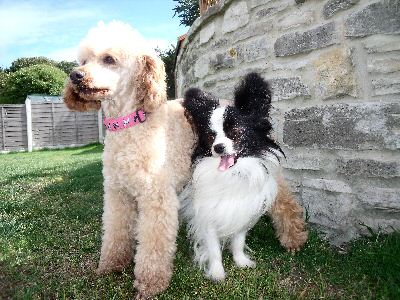
The picture above shows one of the problems with the current height classifications. Puzzle (Papillon) can easily stand underneath Chelsea (Poodle). Chelsea is 5.5kg whereas Puzzle is only 2.5kg, yet he is running against some dogs that are 10kg! Just look at a jump wing and you will see two large gaps between the cups - one at the bottom and a huge one between Medium and Large. Lots of unfortunate dogs fall into the large category when they are only fractionally over the medium height.
The reason, apparently, for not changing things is that 'You shouldn't get a carthorse to do horse racing.' However, in my experience handlers choose the breed/dogs they particularly like living with. You might choose a sheltie - potentially a good breed for agility - which just happens to grow too large for Small or even Medium and it would struggle on the next height up. You might have a Spaniel or Staffie which grows to be slightly too tall for Medium. Of course, you have not chosen the wrong dog. It shouldn't be that you have the 'wrong' dog for agility, but that the current agility heights are wrong for your dog. Agility should be for all dogs.
I believe that handlers should be able to choose any breed or rescue any dog and there should be a place for them in agility. When you get a papillon puppy you don't know how tall it is going to grow and, if he/she doesn't grow tall enough to do the KC small height (350mm), then what are handlers supposed to do? That dog is never going to be able to participate in our sport and yet wouldn't that dog have really enjoyed it given the chance? Even at UKA and BAA, although having lower jumps for the tiny dogs, they still have to compete against all the same much larger dogs as at Kennel Club shows. Puzzle is 9in tall and, although he does his best, the height at Kennel Club is a real struggle for him. He has recently hit two jumps very badly which knocks his confidence and means that he starts 'over-jumping' and taking off too far away, which in turn is likely to make him hit another. This is a vicious cycle which many dogs are in, and is caused because the jumps are too high for the unlucky ones.
Dogs are individuals. They shouldn't be generalised by height at the shoulder. Measuring dogs by height came from the breed ring. What has that got to do with our agility dogs or with their ability to jump? There must be a calculation that would give the stride length of a dog (and therefore their ability to jump). Something like height to elbow, length of back and maybe weight too. There must be a better formula to determine jumping ability.
Would you like to see shows where:-
ABC dogs are given a separate prize-giving from collies and their crosses?
Jumping and Agility have different achievement levels with their own finals? So if your dog doesn't 'do' contacts he could still get to the top in the Jumping category?
There are 5 different height categories so all dogs can be accommodated and jump a height which is comfortable for them?
There are special R & R classes, (Retired and Recovering!), where you can choose which height your dog jumps and every dog gets a little treat on leaving the ring!
In all classes you have the choice between a rosette or a pressie for your dog?
The Grade 6-7 dogs can practice on European-type courses to make them more competitive abroad? Including more skilful weave entries and obstacle discrimination at speed instead of constant pull-throughs and tight distances?
The weave obstacle doesn't change for your dog, but remains at a constant 12 poles? No odd numbers or 6s.
Our larger furry friends aren't unfairly marked on up contacts?
Our larger dogs wouldn't need to struggle on tight 4-yard (3.6m) distances?
Weather conditions are always taken into account when setting a course?
The dogs' safety and enjoyment is paramount?
There is a maximum distance between obstacles for our smaller dogs to prevent them becoming de-motivated or overfaced?
You can train in the ring if you wish?
Your older dogs can drop down a height/level when you feel it is necessary?
Lower level classes are fenced and gated for everybody's peace of mind?
I would like to make things better for our dogs. I propose to introduce some quite different experiences for all agility dogs.
Many people will know by now that I have decided to retire Freeway. She is symptom-less of any problem at present and I want it to stay that way. An MRI and CT scan showed a problem with one vertebra in her spine. This could be operated on but I am simply unable to bring myself to send her in for major spinal surgery when she is so well in herself. In honour of all she has done for me and the enjoyment she has given me over the years, I am naming my new venture after her.
Freeways Agility Break (aka FAB Shows)
Personally I believe the Kennel Club, although great in many ways, has too many grades and not enough jump heights so... with great trepidation I am embarking on some new shows of my own.The four jump heights will be:-
250mm (9.84in) - Yorkies, Papillons, toy breeds etc all line up for this one!
350mm (1ft 1.75in) - Normal Small height at KC
450mm (1ft 5.7in) - Normal Medium height at KC
500mm (1ft 7.68in) and 650mm (2ft 1.6in) - All large dogs can compete at either of these two heights.
These shows will be based on what I believe to be the most important aspect of agility – the happiness and welfare of our dogs. I've always believed that agility is all about dogs – all dogs!
Visit www.dawnweaveragility.com for full details and entry forms.
Pipe Tunnel Fixings
From Bob and Wendy RatcliffeWe have a St. Poodle who is 24 inches at the shoulder. He used to hurtle through tunnels, but was injured on two consecutive days at Tunbridge Wells show.
On the first day, it happened at the centre of a tunnel which was in a straight line. We thought it was odd but just one of those things and did not report it. On the next day, it was at the entrance to a tunnel off a jump. The screams from the dog were terrifying. He sustained an injury to his spine near to the centre of his back which, we hope, the chiropractor has sorted out. Not surprisingly, now he will not go near a tunnels at a show - or even a course in competition - although he do tunnels in training. Obviously, we would not even ask him to do a tunnel fixed in the same way.
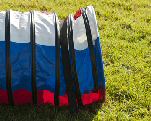
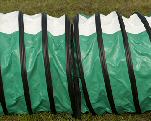
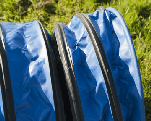
In the past, rigid tunnels have been fixed to the ground with some sort of metal frame and elastic straps (bungies). If they worked their way off onto the plastic it didn't matter too much as they flexed with the force of the dog. Now tunnels are being secured by webbing which does not have any stretch. Instead of being put over the reinforcing rings, they are being pulled down tightly on the plastic in-between. This reduces the diameter and produces pinch points, just inside the mouth of the tunnel, at the centre point and at the exit, forming a hard obstruction as they do not give. Those tunnels measured are only 20 inches at these points even though the KC regulation regarding pipe tunnels states that the minimum diameter should be 609mm or 24 inches. See photographs below.
Tunnel mouth Centre of tunnel How tight is that? We know there were several people willing to support us at the Tunbridge Wells show, but we stupidly did not take their names and addresses. The attitude of the show organisers was that as his was the only injury it must be the dogs fault.
Has anyone else had this problem? This would seem to be an accident waiting to happen as clearly these tunnels fixed in this way do not comply with the KC regulation?
If you are willing to support us regarding this problem, whether you spoke to us at Tunbridge or not, could you contact us at acecliffe@vodafoneemail.co.uk
Reply from Tunbridge Wells...
We are of course very sorry that your dog had a problem and hope that he has made a full recovery and regains his confidence with tunnels. There were no other reports of any problems with the tunnels at Tunbridge Wells and there were 8 full rings each day including lots of larger breed dogs. All the details of this incident, including statements from witnesses, were sent to the Kennel Club and the KC decided that there was no case to answer.The equipment used was from a very well known and well thought of supplier. We would agree that the tunnel fixings need to be as safe as possible and were pleased to see at a show last month that the fixing straps are now made of elastic rather than webbing. These straps and the ones in use at our show were fastened with Velcro that can and does sometimes undo under pressure. Some of the other straps supplied by other manufacturers do not have any give in them and are securely fastened and so cannot self-release when necessary. We are pleased that people are being made aware of the potential problems with straps like this.
Mandy Dumont - TWDCS Agility Section Chairman (29 August 2011)
Judging Spouses & Close Relatives
From Carol HunkinHaving read the information on Agilitynet stating The Kennel Club's position on judging of spouses and family members I thought I would send my comments to you in case they are of interest to other Agilitynet readers. As the partner of someone who has regularly given up her precious time to volunteer as a judge at agility shows I actually find this regulation quite offensive.
Whilst I am certainly no expert on either agility or any other canine discipline that The Kennel Cub is tasked with regulating, my understanding is that the judging of these different disciplines is not the same. Breed shows have, by their very nature, a subjective element. The impression a dog makes on an individual person is part of the assessment process and in every instance judgements are made from close quarters that may not be immediately obvious to onlookers.
In agility, on the other hand, decisions are objective. In the vast majority of cases, they are immediately apparent to all concerned. A dog knocks a fence or he/she doesn't. A dog gets a contact or she/he does not. The fastest dog with the lowest number of faults wins the class. Considerable time and money have been invested to provide timing systems that are independent of human error.
Until there is enough money in the sport to ensure that all events can operate effective video recording and playback systems then, yes, I am sure that on extremely rare occasions genuine mistakes can be made such as when a dog gets a contact by a nail. In these circumstances one person's decision needs to be final, but, to imply that the chance of bias - actual or perceived - amongst those taking on this responsibility is greater than the negative effect of excluding competitors from classes within a family sport is very, very sad. Who wants this?
My partner is one of many who generously offers to forgo time with her family and her own chance to compete in order to spend a day supporting an event for the good of the sport she loves. I am very happy to say I have not met anyone in agility who, I believe, would offer to take up a judging appointment for any other reason. As someone who appreciates the opportunity this gives me to compete, I wish to applaud and defend this generosity and integrity.
Any personal feelings on the subject are surely in addition to the extra work this will give event organisers . I wonder how The Kennel Club proposes to prevent individuals from withdrawing from judging appointments when, I believe, it is unlawful to compel someone to work under a valid contract of employment, let alone someone who is in a voluntary position and receiving no benefit.
Finally, unless The Kennel Club has attributed a wider definition than is customary to the term 'spouse' - and I couldn't find anything on their website to answer this question - it seems that I will never fall foul of this ruling in the same way that other members of the agility community will, which - beneficial to me or not - is offensive in itself.
From Jill Spurr...
I'm beginning to feel a little lonely. I am one of a seemingly small group of people who really isn't disturbed by the new rule about judging immediate family. There are a couple of good reasons for this.Firstly, people are acting like some random person in the KC woke up one morning and decided to impose the immediate family rule on us. This rule came from the Activities Committee, admittedly after an incident from obedience (spouse judging partner to a win in C) but the collected representatives of all the canine activities couldn't come up a good reason why it shouldn't refer to all canine activities. Agility is represented on that committee, by people elected by the agility community to represent their area! So lets stop talking like Agility was out of the room when all this happened. Oh, and lets not forget that they passed another rule at that same meeting, giving judges the ability to eliminate for double handling. No one is up in arms because that one slipped through the net without consultation.
It has been mentioned that this rule is to bring us into line with breed. Utter tosh. If you think this is rough, you need to see the 'Thou shalt not judge.. ' rules for breed. You cannot judge a dog you have bred - ever. Does that sound like we are coming into line with breed? Not to me.
And while we are on the subject of breed - why oh why does the agility community always blame breed for anything it doesn't like? The post to which I am answering - ironically after claiming not to be an expert! - mentions that breed is subjective, agility is objective. That's kind of naive. There is always an element of judge's choice in both (and every other discipline). That's why you have one judge in the middle of the ring, and don't take a consensus of what has happened from those watching. A dog in breed complies with the breed standard or it doesn't, it has the correct angulation, movement, coat type etc. or it doesn't. The judge must then choose what they believe to be the dog most akin to the breed standard, which is where the subjective element comes in. But surely my interpretation of what constitutes a G3 course is no less subjective than a breed judge's interpretation of the breed standard? We don't get told what to put into courses, and must make a judgement call as to what is appropriate. And often - very often - faults are also a judgement call. Is that a refusal? Did a part of that dog touch the contact as it flashed past?
But perhaps the most compelling of reasons is simply perspective. I don't feel that my integrity is being called into question. Why would this rule do that, more so than the rule that bans dogs in my ownership - or part ownership - from competing in other people's classes on the day I judge? If the immediate family rule is only because judges cannot be trusted, what does not letting their dogs run under each other say? Or, is it just to stop other competitors, commenting and possibly even believing that Mrs X only won/qualified/gained points because Mr X was judging? While we would like to think that everyone in agility is honest and true, we also cannot deny the various rumours about wrong-doing, or even people confessing to pressuring decisions, like forcing course changes or reruns, that should be reported and not dealt with on the day.
Equally, I am at a loss how I can moan about a rule that will amount to losing a run or two at most. I have four dogs in three different classes, including a different height category, and my partner has three dogs in two classes. Yet in six years my partner and I have been together we have judged each other a handful of times. And that's with us taking up to ten judging appointments EACH in some years. Don't get me wrong, I would love to continue to compete with my partner as judge - he is a talented and understanding course designer, and a hard-working and compassionate judge, as should all judges be. But to put this in perspective, I lost nine runs last year because my bitch was in season. More tellingly, I opted not to run several courses, because of weather conditions, and/or poorly designed, grade inappropriate courses. And, I lost 17 weeks of competition when my best dog was seriously injured by a lethal but perfectly legal light plastic pole. So in the greater scheme of things, as indignant as some people are, this new rule is the least of our problems. (20 June 2011)
From Anne and Mike Neave....
In view of the recent Kennel Clubs press release, please remove our names from the Judges A-List. After much discussion, we have decided that neither of us will judge under the new ruling coming into effect next year for these reasons:-
- The taking of arbitrary decisions from remote executives without proper consultation with the elected representatives of the sport.
- Far from endorsing a judge's integrity, this decision has, in our opinion, the opposite effect implying lack of trust from people who give of their time freely and willingly to put back something into the sport we all love.
The next logical step to this ruling could possibly be to apply it to Scrimers, Scorers or any member of a ring party. Further steps could include members of the ring party and judge's training club or any one they themselves train. And then there are the dogs you have bred, people you camp with and become friends with through agility. The list could become endless.
It has been mentioned that this ruling will help in the admission of agility into the 2016 Olympic games. If this is true, it seems a very poor reason to change the rules for the majority for the sake of a very, very small number who would actually attain such status.
It has also been mentioned that this ruling brings agility in line with professional umpires and referees. When agility judges become paid professionals, that would be the time to put restraints as to who they can judge.
As to the future, the impact of this ruling may make the administration of and partaking in agility much harder to cope with than currently.
We will watch with interest who else feels as we do and hope that sense in the end will prevail. A sad day for agility. (16 June 2011)
Aluminium / Rubber Coated Agility Contacts
From Nigel Staines (Dark Destroyer Agility - Alston, Cumbria)
In one word - WOW!
Having competed for almost 20 years, the introduction of the rubber contacts in the UK has to be the most significant change since electronic timing was introduced. They have been available abroad for several years and like many things why has it taken so long to see this kind of quality over here in the UK, but, wait no longer. First Contact had them at the WAO but other UK agility equipment suppliers are looking into them as well.
As most people who know me, my dogs fitness and safety are paramount. The rubber contacts take safety to a new level, better grip, cushioning and no nasty slats to ''knock up' the dogs toes/knuckles. More confident entry on to the contact can be achieved and no sliding to a halt on unless well worn sandpaper type finish.
From a maintenance point of view, just great, no annual painting, no rot, no splits along natural wood grain, no rust on joints - just a fab looking piece of equipment that lasts.
I just wish, wish, wish, this equipments was made standard ASAP as I am already seeing dogs getting confused by the different surfaces, including my own on a couple of occasions. The sooner the rubber contact can be used at all agility tests the better.
Winnie Whispa Snowy Pebbles Give an Old Breed A Chance!
From Donna CawleyThe Mexican Hairless dog is not everyone's ideal agility dog. The breed is a very ancient one and dates back to the Aztecs. Evidence of their existence has been found from Pre-Columbian times.
You may not be aware but this traditional breed, known as Xoloitzcuintle (pronounced show-low-it-squint-lee), has both hairless and coated varieties. The breed comes in three sizes - Miniature (9 – 13in), Intermediate (13 – 18in) and Standard (18 – 23in). They are a very intelligent breed that is quick to learn. They love to work closely with their owner and are very fast and agile. In The States, they excel at agility with at least one dog having many titles after his name. In the UK we currently have an Intermediate Mexican Hairless that is taking the Flyball world by storm.
These are a breed that is very limited in numbers. There are only 62 in England and around 4000- 5000 remaining worldwide. After a 9 year wait, the first litter of Standard size Mexican Hairless have recently been born in England. There are four adorable coated bitches available.
It is very important to promote dogs in a positive manner so that people can gain an understanding of their abilities and personalities. Wouldn't it be amazing an amazing advert for the sport if we could see a Mexican Hairless compete at Agility or Obedience. Why not be that person who is willing to give an old breed a chance.
For more information, ring Donna Cawley on tel.– 01773 714320. See advert in Flea Market.
Dog Walkers at Risk if England's Forests are Sold
From The Kennel Club
The Kennel Club has warned that dog walkers will face increasing restrictions in the countryside if England's forests are sold to private buyers.
The warning comes as the Department for Environment, Food and Rural Affairs today launched a public consultation to consider the future of Forestry Commission land, a large proportion of which has been identified as a target for sale by the Government.
The Kennel Club's KC Dog group campaigns for dogs and their owners to enjoy maximum access to the UK's open spaces. Forestry Commission land is currently one of the few places to promote off-lead exercise for dogs wherever possible and is not subject to dog control orders under the Clean Neighbourhoods and Environment Act 2005. Under a concordat signed in 2005, the Forestry Commission and the Kennel Club pledged to work together to improve human health and well-being through dog ownership, whilst respecting the forest environment and the needs of other users.
The Kennel Club is, therefore, highly concerned that private landowners with commercial interests may not show the same regard as the Forestry Commission for dog walkers. It warns that the privatisation of Forestry Commission sites could limit areas for off-lead exercise, push dog walkers onto farmland and wildlife hotspots, alter or revoke additional access permissions, such as those for sled dogs, and introduce unregulated parking charging.
Commenting on the Government's plans, Caroline Kisko, Kennel Club Communications Director, said: 'The privatisation of England's forests poses a real threat to dog owners across the country. The ability to freely exercise your dog in a safe open space is an essential part of promoting a dog's health and welfare. The implementation of these proposals will put this at risk and therefore have a devastating impact upon the nation's dog walkers and their dogs.'
The Kennel Club is calling upon all dog owners to respond to Defra's consultation as a matter of urgency. A copy of the consultation document is available through both the Defra website (www.defra.gov.uk/corporate/consult/index.htm) and the Forestry Commission website (www.forestry.gov.uk/england-pfe-consultation) and closes on 21st April 2011. All consultation submissions should be sent to: Public Forest Estate Consultation Co-ordinator, Forestry Commission England, 620 Bristol Business Park, Coldharbour Lane, Bristol BS16 1EJ. (30/01/11)
From Leanne Alder...
I noticed your article about saving our woodland and this is the campaign that is being advertised at woodland areas in Nottingham. Apparently they are campaigning on behalf off the country so would be the best way for everyone to help out. www.38degrees.org.uk/page/s/save-our-forests (31/01/11)
Green Belt Issues
From Andrea Gough
I am being told by the Enforcement Officer at Cheshire West that I can only use my paddock for 28 days a year for training my dogs. Also, that I cannot store the agility equipment on the land and have to have a trailer to carry it on and off the field.
We are, of course, seeking the advise of a Planning Consultant to see if we can overturn this ruling. I wondered if anyone has previous knowledge of this. The issue is, I feel a national one, and I believe also affects, and is now affecting, people who have horse jumps in a field.
If this is allowed to go through, then it will affect anyone in the Cheshire West area – not only individuals but some clubs that are using the land in a far more proactive way than I was looking to do. It only takes one complaint from a member of the public to instigate action by the Planning Office.
Please email your experiences to me at andreacgough@btinternet.com
Height of the A-frame
From Christine BrownFollowing an incident at the Suffolk Five Rivers Show this year, I would like to propose a change to rule Kennel Club rule H(10(b3.A . As I understand it, we've all been breaking the rules if we use a lowered a-frame in a Veterans or Allsorts class. For some years this has been common practice to minimise the impact on the dog's front lets on ascending and descending the obstacle.
I would like to propose this amendment which I believe will allow us so we can continue to run these very popular classes. This wording, I feel, covers the possibility of using lowered dog walk as well as A-frame. It should allow all dogs - not only oldies but newbies as well - to have a proper go at agility in competitive environment without too much pressure to do full height equipment.
Change to: When setting a Special class, societies can specify in schedule dog's eligibility and also the specifications for all equipment to be used which must not exceed maximum dimensions as laid out in rules.
We can only get things changed if there is enough support so please help me! If you want to express your support for this proposal please email either your agility rep or Joanna Nosalik at Kennel Club direct (31/10/10)