On the road again...
 Agility
as a sport requires us to do a lot of travelling by car with our dogs. Most of us aren’t lucky
enough to have a training field within walking distance so it's a back and forth possibly
several times a week. And then there are the shows which are dotted all over the country. Did
it ever occur to you that driving to agility could be a dangerous activity? Agility
as a sport requires us to do a lot of travelling by car with our dogs. Most of us aren’t lucky
enough to have a training field within walking distance so it's a back and forth possibly
several times a week. And then there are the shows which are dotted all over the country. Did
it ever occur to you that driving to agility could be a dangerous activity?
Well-known professional trainer Elicia Calhoun recently found out the hard whay when the
vehicvle she was driving was involved in an accident near Tuscon, Arizona, throwing her six
dogs out of the car and into the desert.
Three of the dogs suffered serious injuries, but are expected to recover. One dog, a
13-week-old puppy, was killed at the scene, while another was later struck and killed by a
passing vehicle.
Last night, as social media announced news of the accident, one of Calhoun’s dogs, Tobie,
was still unaccounted for and presumed missing in the desert.
Reports posted on Facebook indicated that Calhoun was hospitalized and treated, but checked
herself out in order to spend the night in the desert searching for her missing dog.
This morning, Calhoun and a group of volunteers continued their search for Tobie, a brown
and white Border Collie bitch. By mid-morning, news began to appear online that Tobie had been
found unharmed. Reports posted in a Facebook group set up to help find Tobie indicated that the
dog looked good and was being taken by Calhoun to be checked by a veterinarian.
About 4,600 people joined the
Facebook group to
show their support for Calhoun and her dogs.
When tragedy strikes someone in our community, social media allows dog people to rally
support in real time. Volunteers have reportedly collected more than $20,000 on Calhoun’s
behalf. Donations have been made online through
FundRazr and, according to her
Facebook page, Elicia is also accepting donations to her personal Paypal account.
For those of us who travel to conformation and performance events around the country, we
understand all too well how this type of tragedy can happen. It is a credit to our community
that the response to Calhoun’s accident has been so swift.
Volunteers on the ground and supporters online have proven once again that when there’s
someone in need, dog people are only too willing to pitch in and help.
----------------
Calhoun fell asleep at the wheel Monday resulting in a crash.
The accident happened early Monday morning near Willcox, roughly 80 miles east of Tucson.
Calhoun is a nationally known agility trainer based in the Valley.
As of Tuesday morning, roughly 4,600 people had joined the Facebook group. Volunteers said
they collected $15,000 to help with the search.
Calhoun said airplanes are flying over the desert to search for Tobie.
This past weekend she and her dogs were at a competition in Odessa, Texas.
Calhoun was driving home early Monday morning along I-10 near Willcox.
Her 2007 Hyundai crossover hit an 18-wheeler semi truck and rolled over several times. All
six of Calhoun's dogs were ejected upon impact.
Three dogs suffered serious injuries but are expected to survive.
However, a 13-week-old puppy died instantly and two others went missing.
Calhoun checked herself out of the hospital with a punctured lung to go looking for her
missing dogs.
Nika, a border collie, was found dead around 7 p.m. Monday. Calhoun says Nika was hit by a
car.
Calhoun and her volunteers set up camp on the I-10 until Tobie was found.
"Right now they are my life," said Calhoun on Monday. "I would do anything to get them back.
I would trade my life for theirs. I will not leave this area until I know where my dogs are."
You can
check out the Facebook group established to help Calhoun find her dogs, or the
fundraiser to assist
in her recovery.
--------
initial info)
.......six dogs were thrown from the car of an internationally known agility trainer this
morning after the vehicle they were riding in clipped an 18-wheeler and rolled twice. I don't
know all the details, but 1 dog was killed on impact, 3 are at a clinic being treated, and 2
are missing in the desert. We are trying to find the two missing. There are several people out
searching the deserts right now along the stretch of I-10 near mile marker 351 outside of
Wilcox, AZ. If anyone else is in the area and can help, I'm sure they would be very grateful.
The owner has checked herself out of the hospital (against orders, I'm sure) to find her dogs.
The two missing are Tobie (far left) and Nica (2nd from right). I will update as I hear new
information, but for now we just need to get people out there to help find them. It's a huge,
vast area with temps soaring past 100 degrees, and I don't think the dogs are snake-trained.
Time is of the essence! You can email me for more information at
PetsWeekly@gmail.com. Here is the pic once more and thanks for all of your amazing
support in sharing and getting word out so we can find these beautiful animals!
(Update 1)
Elicia has a punctured lung and other issues, but despite this - checked herself out of the
hospital to search for her dogs.
(update 2)
Destiny suffered a dislocated hip and torn pad but otherwise is OK. Kelpie pup Tsunami was
killed instantly. Still looking for Sweet girls Tobie and Nika.
(update 3)
Nika has been found; she was hit by a car and is dead.
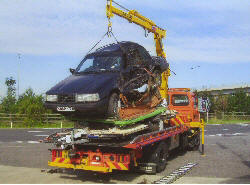
For Malcolm Page, what started as a routine drive nearly turned to disaster.
In
2007 Mac Page was on his way to a show at the East of England Showground (Peterborough) when a
refuse lorry unexpectedly crashed into his car and caravan. The air ambulance was scrambled.
The crash caused chaos. He managed to escape through the
window of the car with only a scratch but his two dogs, Fly and Annie, though uninjured, had to
be cut free by fire-fighters. It was an agonising wait.
Lucky to be alive
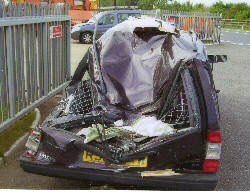 After the event, Malcolm commented, ‘The need for proper
dog cages is obvious from the photos. I believe that when my car got crushed, the cages being
purpose-built of heavy mesh took some of the impact. The back didn’t crush right down onto
the car where the dogs were. After the event, Malcolm commented, ‘The need for proper
dog cages is obvious from the photos. I believe that when my car got crushed, the cages being
purpose-built of heavy mesh took some of the impact. The back didn’t crush right down onto
the car where the dogs were.
He also told The Evening Telegraph, 'If (Fly and
Annie) weren't in a cage in the back, I think they would be dead. I
paid £640 for that cage, and it was money well spent.’
Mac was told
by the recovery firm that approximately 80% of accidents with dogs in cars that are uncaged jump
through the windows when the glass breaks and are either killed on the road or lost. Most
people seem to think that their dogs are safe in their cars because they have a front or rear
guard but they don't think about the windows being smashed and the dogs jumping out into the road.
Food
for thought
Do you
need to reconsider the dogs' safety when travelling. According to the Royal Society for the Prevention of Accidents,
in a crash, an unrestrained pet could be seriously injured or
injure people in the car. At 30 mph, for example, a 50lb (22.5kg) Border Collie would be
thrown forward with a force equivalent to almost nine x 12st men.
Gill Arney of
Safedog, commented, ' I'm old enough to remember the days when we didn’t have to
wear seatbelts in cars. Now I can't imagine travelling in a car without wearing a belt.
The same may be said in future years about the way we used to transport our dogs around ‘in the
old days'.
If you do not have secure caging you might be putting not
only are you putting yourself and your dog at risk, you
might be breaking a legal requirement. Car harnesses are
useful if your car is too small for a crate, or if you have a crate in the back and need the
facility for an extra dog on the back seat.
Although The Welfare of Animals
(Transport) Order 2006 is the main piece of legislation regarding transport of animals, it
appears to relate to transportation for commercial purposes. It states that no person shall
transport any animal in a way which causes or is likely to cause injury or unnecessary
suffering to that animal.
Section 57 of the Highway Code,
however, seems more specific
57: When in a vehicle make sure dogs
or other animals are suitably restrained so they cannot distract you while you are driving or
injure you, or themselves, if you stop quickly. A seat belt harness, pet carrier, dog cage or
dog guard are ways of restraining animals in cars.
Many vehicle accidents involve dogs
traveling in cars, ranging from minor rear end shunts to vehicles rolling down hillsides. In
the more severe incidents, the cages have prevented items from outside the car protruding into
the boot. It has obviously secured the dogs in the load area and ensured no contact with the
occupants during the crash and contained the dogs after the crash.
Unfortunately where dogs are not caged
it does seem that frightened dogs have escaped from damaged vehicles only to come to harm from
cars unable to avoid them. It can still be traumatic for the owners to know that the dogs are
well but have run off while possibly in shock. In these days of cars having automatic fuel cut
off switches surely the best place for a dog is to be contained in the vehicle where the owners
can help and comfort them if necessary.
Ever since Sean Davies, the MD of
Guardsman, saw his first crash test of one their dog guards for a Ford Galaxy he has decided to
remove every item from his rear parcel shelf including a road atlas. He realised that the
impact of even a hard back book at the 30mph could be potentially devastating.
Although the investment in a well built
custom made cage can be substantial, it can be life saving for both the dog and the occupants
of the vehicle. Cutting corners in build quality, mesh size and fitment may save money in the
short term but may be cause for regret in the future.
Your help with research
Since then we have built up a relationship with
MIRA (http://www.mira.co.uk) (the Motor Industry Research Association) and have had many of
our vehicle related products crash tested there. I would also like to ask that if anyone has
been unfortunate to have been involved in a road traffic incident (I don’t think the police
refer to them as accidents any more) with dogs and would be prepared to share the experience
could they email me at
sean.davies@athag.co.uk.
I would like to build a library of people’s experiences for future reference. Also we are
always keen to improve our products and if anyone has suggestions we are always pleased to hear
from them.
long term manufacturer of vehicle dog
caging, has commented that since the company was founded over 40 years ago After
The Welfare of Animals
(Transport) Order 1997 is the main piece of legislation regarding transport of animals. It
states that no person shall transport any animal in a way which causes or is likely to cause
injury or unnecessary suffering to that animal. This means that by
letting your dog travel unrestrained or in a way that has not been specifically crash tested,
you are putting all involved at risk and breaking this legal requirement.
------------------------------------------------------------------------------------------------------------------------------------------------------------------

Lizzie Langwade has been
training in Agility since the age of 12 and started competing in 2004. She currently owns 3
collie dogs: two rescues – Max (Grade 6) and Ted (not yet competing) – plus puppy Hydro and a
golden retriever bitch, affectionately known as Pig who’s now retired to anysize.
Dog Car Safety
On the road again

Agility
as a sport requires us to do a lot of travelling by car with our dogs. Most of us aren’t
lucky enough to have a training field within walking distance so it's a back and forth
possibly several times a week. And then there are the shows which are dotted all over the
country. Did it ever occur to you that driving to agility could be a dangerous activity? For
Malcolm Page, this routine activity nearly turned to disaster.
In 2007 Mac Page was on
his way to a show at the East of England Showground (Peterborough) when a refuse lorry
unexpectedly crashed into his car and caravan. The air ambulance was scrambled. The crash
caused chaos. He managed to escape through the window of the car with only a scratch but his
two dogs, Fly and Annie, though uninjured, had to be cut free by fire-fighters. It was an
agonising wait.
Lucky to be alive
 After
the event, Malcolm commented, ‘The need for proper dog cages is obvious from the photos. I
believe that when my car got crushed, the cages being purpose-built of heavy mesh took some
of the impact. The back didn’t crush right down onto the car where the dogs were. After
the event, Malcolm commented, ‘The need for proper dog cages is obvious from the photos. I
believe that when my car got crushed, the cages being purpose-built of heavy mesh took some
of the impact. The back didn’t crush right down onto the car where the dogs were.
He also told The
Evening Telegraph, 'If (Fly and Annie) weren't in a cage in the back, I think they would
be dead. I paid £640 for that cage, and it was money well spent.’
Mac was told by the
recovery firm that approximately 80% of accidents with dogs in cars that are uncaged jump
through the windows when the glass breaks and are either killed on the road or lost. Most
people seem to think that their dogs are safe in their cars because they have a front or rear
guard but don’t think about the windows being smashed and the dogs jumping out into the road.
Food for thought
Do you
need to reconsider the dogs' safety when travelling. According to the Royal Society for the
Prevention of Accidents, in a crash, an unrestrained pet could be seriously injured or injure
people in the car. At 30 mph, for example, a 50lb (22.5 kg) border collie would be thrown
forward with a force equivalent to almost nine 12 stone men.
If you do not have secure
caging you might be putting your dog at risk - and you might be breaking a legal requirement.
Car harnesses are useful if your car is too small for a crate, or if you have a crate in the
back and need the facility for an extra dog on the back seat.
From
www.direct.gov.uk/en/TravelAndTransport/Highwaycode/DG_069853
Sean Davies the M.D. of
‘Guardsman’ long term manufacturer of vehicle dog caging has commented that since the company
was founded over forty years ago we have heard of many vehicle accidents involving dogs
traveling in cars. These range from minor rear end shunts to vehicles rolling down hillsides.
In the more severe incidents the cages have prevented items from outside the car protruding
into the boot. It has obviously secured the dogs in the load area and ensured no contact with
the occupants during the crash and contained the dogs after the crash. Unfortunately where
dogs are not caged it does seem that disorientated dogs have escaped from damaged vehicles
only to come to harm from cars unable to avoid them. It can still be traumatic for the owners
to know that the dogs are well but have run off while possibly traumatised. In these days of
cars having automatic fuel cut off switches surely the best place for a dog is to be
contained in the vehicle where the owners can help and comfort them if necessary.
Although the investment
in a well built custom made cage can be substantial we believe it can be life saving for both
the dog and the occupants of the vehicle. Cutting corners in build quality, mesh size and
fitment may save money in the short term but may be cause for regret in the future.
After seeing my first
crash test of one our dog guards for a Ford Galaxy many years ago I decided to remove every
item from my rear parcel shelf including a road atlas. I realised that even a weighty hard
back book at the 30mph could be potentially devastating.
Since then we have built
up a relationship with MIRA (http://www.mira.co.uk) (the Motor Industry Research
Association) and have had many of our vehicle related products crash tested there. I would
also like to ask that if anyone has been unfortunate to have been involved in a road traffic
incident (I don’t think the police refer to them as accidents any more) with dogs and would
be prepared to share the experience could they email me at
sean.davies@athag.co.uk. I would like to build a library of people’s experiences for
future reference. Also we are always keen to improve our products and if anyone has
suggestions we are always pleased to hear from them.
T.+44 (0)1827 713040
is well-known among the world’s serious agility competitors. The national and world champion
is a top performer who has represented the United States for five consecutive years as a World
Champion Team member.
Calhoun has proven just how tough she and her dogs are in the agility arena.
On Monday, June 11, 2012, her strength was tested in another way when the vehicle she was
driving was involved in an accident near Tucson, Ariz., throwing her six dogs out of the car
and into the desert. Calhoun was returning from a competition held in Odessa, Texas.
|