Time to say thank
you...
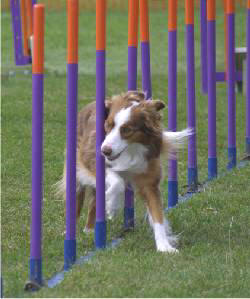 It
seems there are too few opportunities in life to celebrate and thank people so one should make
the most of them. Subsequently, Lesley Harpley felt this would be the right time to mark
Star’s recent passage into Senior with an acknowledgement of this amazing dog and those who
have helped them along the way. It
seems there are too few opportunities in life to celebrate and thank people so one should make
the most of them. Subsequently, Lesley Harpley felt this would be the right time to mark
Star’s recent passage into Senior with an acknowledgement of this amazing dog and those who
have helped them along the way.
Some people know that, at the age of 15
months, Star collided with a fence and broke her second vertebrae! According to the veterinary
specialist, she should have been paraplegic.
It was a very difficult period, with
hard decisions to give her a chance to live, but after five months of cage rest, she was back
doing agility. Before long she knocked up a good handful of second and third places in
Novice.
Then, inexplicably, around three
years old, she began to slow down and become quite lethargic, often with tummy upsets and
her coat became woolly. I kept going back to the vet, but repeated tests were
inconclusive.
Diagnosis
After winter ‘rest’ in March 2003, I went back to the vet and specifically requested a
test for Addisons disease, having searched the Internet.
Star's weight had dropped to just
12.5kgs, a loss of 21% of her normal body weight. If you think about this as a loss
of muscle tissue, it must have been nearer 50% of her muscle weight. The test results
were conclusive, and Star started her permanent medication with almost immediate results.
About Addisons Disease
Having come across numerous dogs in agility with
Addisons, personally I am convinced it is significantly more common than vets generally
realise. I believe that most vets generally only come across it in a state of ‘crisis’
because the ordinary pet owner would not generally notice the symptoms or put them down
to normal aging. By this stage, it is often too late for the dog to make a total
recovery.
In agility however, we have a uniquely measurable
gauge of how fit our dogs are and we should definitely ‘listen’ to what they are telling
us. If treated early, dogs can make a full recovery and have a great quality of life. So
early diagnosis becomes the key.
In the simplest terms, Addisons is a condition whereby
the cortex of the kidney fails to work and so the dog is unable to balance the hormones
related to the body’s management of stress. Left untreated, this can throw out other
hormonal balances in the body and the dog will gradually decline. The good news is that
with medication, dogs can make a full recovery and lead a full and active life.
The most common symptoms are: lethargy and depression;
weight loss; and diarrhoea and/or sickness. A symptom which is not acknowledged, but I
have found repeatedly in talking with Agility people, is an unusually coarse, woolly or
bushy coat. Blood and urine tests will usually show ‘odd’ results, but these may be at
the margins of ‘normal’ readings. In Star’s case, she was actually cleared by the Royal
Veterinary College in September, six months prior to me requesting the definitive
Addisons test.
I believe Addisons is often over-looked because vets
normally only see the extreme ‘pet-dog’ cases that have reached crisis and because the
symptoms are often intermittent. Addisons has been called the ‘great pretender’ because
of similarities with more ‘common’ conditions.
If in doubt about your dog’s health, don’t be put off.
Keep going back to your vet and ask for any tests you feel may help.
These notes are my personal opinion, I am not
qualified in veterinary practise and this perspective is purely as a lay person.
 Back
to Agility Back
to Agility
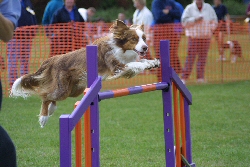
In September 2003, she achieved a
second place in Novice Jumping at Daventry and was back to her usual self, barking with
excitement around the course. For me, the results are simply a measure how well Star is
feeling.
I
was amazed and thrilled when she gained a first place in Novice Jumping at Supadogs last
year and even more surprised when she won into Senior at Dashin’ Dogs at Easter by
winning both Novice Agility and Jumping on the same day, followed by Novice Jumping at
Shuttleworth.
Thank
you
We have been helped by several great clubs and instructors over the years, to whom we are
indebted, but three people in particular deserve a special mention.
-
Kathryn Tasker who first
trained Star as a youngster and who knocked me into shape to win out of Starters
-
My former husband and fellow
instructor at our small club, Colin Harpley, for years of practical support
-
Jonathon Watts for re-gaining
our confidence this year and (almost) convincing me that a 44 year old can still run
like a 20 year old.
Thank you very much!
 Star
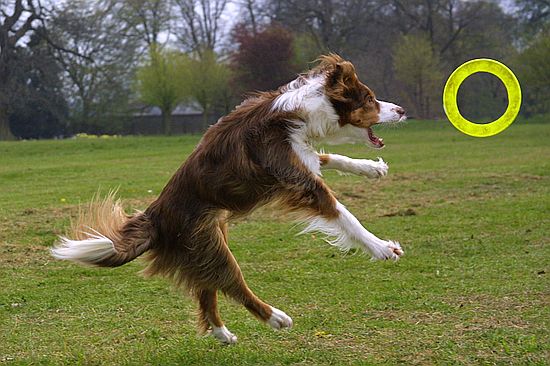
is seven this year. I can hardly expect her to achieve places in Senior or even
Intermediate, but I can make sure she enjoys her agility. Star
is seven this year. I can hardly expect her to achieve places in Senior or even
Intermediate, but I can make sure she enjoys her agility.
So, we’ll be the ones making lots
of noise around the course and bouncing about with a toy (in the way only Star can) at
the end of the run, whatever happens.
I love being in the ring with her, but
I love seeing her run on a beach even more. I feel privileged to live with and love this
fantastic dog, I learn from her every year, the main one being ‘Agility is a celebration of
life, but it isn’t life itself’.
Thank you Star!
 About
the author... About
the author...
Lesley Harpley has enjoyed agility for over ten years, initially with her two rescued
crossbreeds. Star was her first puppy and first WSD.
She now lives in the
USA.
|