| |
Make sure your agility dog is not
their next meal...
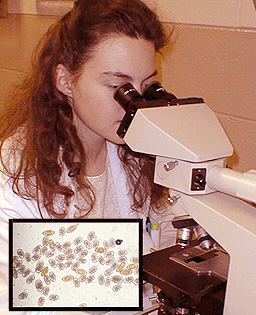 To
a certain extent, ignorance is bliss and indeed, the vast majority of well cared for pets in
the UK and Ireland will never suffer the serious consequences of a massive worm burden.
However, an appreciation of what we are actually preventing when we cajole Rover to consume
'this yummy tablet' is a vital piece in our armoury to a long-lived, healthy and happy pet. Parasitologist
Dr. Jacqueline (Jackie) Boyd explains. To
a certain extent, ignorance is bliss and indeed, the vast majority of well cared for pets in
the UK and Ireland will never suffer the serious consequences of a massive worm burden.
However, an appreciation of what we are actually preventing when we cajole Rover to consume
'this yummy tablet' is a vital piece in our armoury to a long-lived, healthy and happy pet. Parasitologist
Dr. Jacqueline (Jackie) Boyd explains.
Worming is one of those aspects of pet
care where everyone seems to have their own particular preferences and practices. Some dog
owners who insist on worming - or to be more accurate, de-worming - on a rigid schedule and at
the other end of the spectrum others wait for symptoms of worm infestation before they reach
for the tablets and chopped liver. Personal experience has a lot to do with how you view your
own particular (de-) worming schedule.
Our dogs are constantly exposed to
environmental challenges. Agility dogs are typically exposed to new environments on a regular
basis and this combined with often long (and sometimes stressful) journeys, and the physical
expenditure that agility training and competition involves means that we have a serious duty of
care to our beloved dogs. Parasite prevention is one aspect of this care process in which we
can have a real input.
What's lurking
there?
There is a massive collection of parasitic organisms just lurking out there waiting
to move into or onto Rover either temporarily or permanently. The modern day domestic dog is
further challenged by his environment which is typically VERY parasite friendly. Now, while all
responsible dog owners "scoop that poop", how often have you walked your dog in areas covered
in excrement in various stages of decay. You can bet that those very same owners who
conveniently "forget" to pick up their pets poo are the ones who think that de-worming is not
really a necessity.
While on this subject, no matter how
diligent you are with your own picking up, unless you catch the offending pile before it
actually hits the ground, there is always likely to be a degree of contamination. Indeed,
studies examining contamination of parks and playgrounds with dog-derived parasite eggs
reveal scarily high concentrations, even where poo picking is in force. Even worse
are those occasions when Rover has a tummy upset (maybe after eating the wormy bunny
earlier in the week) and it is nigh impossible to gather it all. I know - it's happened
to me. Even in your own yard/back garden, diligent poo picking is a vital weapon in the
prevention of contamination by worm eggs; particularly if you have young
children. Ideally poo should never be left longer than a few minutes, although in the
real world a daily sweep is perhaps more feasible.
The faecal oral route of transmission
is typically the one of choice for most of the major types of parasites that are likely to
affect our dogs. Essentially that means that the worms live and reproduce in the gut, releasing
eggs or larval worms in the faeces. These then contaminate the external environment and wait
for their next friendly host to come along, when they might stick to grass ingested by the dog
or stick to the fur to await being licked off. This is typically when young children might also
become infected by accident.
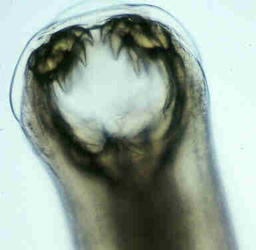 Hookworms Hookworms
One of the less nice parasites is the dog hookworm, Ancylostoma caninum which
penetrates the skin of its new host and migrates within the host body to its favourite
location. This parasite is a major health hazard to nursing pups, as it can often lie
dormant in the skeletal muscle of the bitch, and become reactivated by hormonal changes
associated with pregnancy and lactation, whereby it is typically transmitted via
milk. Infected puppies can rapidly become very anaemic, the parasite essentially
"sucking" blood directly from the intestine. This particular worm also has the nasty
habit of occasionally infecting humans, which are essentially dead-end hosts. However,
the worms will migrate randomly through the body attempting to find a favourable
environment for their continued development. This often manifests itself as itchy skin
lesions; do a Google search for cutaneous larval migrans and you'll see some attractive
photos - if they don't encourage you to pick poo and worm your dog, nothing will!
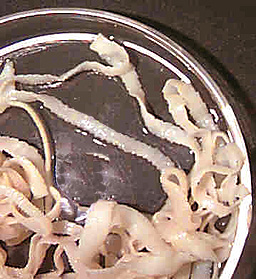 Tapeworms Tapeworms
Our dogs also have attractive habits of acquiring fleas either from their cat buddy,
or after that big rabbit-ing session. Fleas, while not only causing distressing
itching and scratching, are also associated with the spread of certain species of
tapeworms, so it is vital that in also worming your dog (and cat if appropriate), make
sure you are also treating for fleas and following flea prevention strategies. In
much the same way that humans can also be accidentally infected by dog parasites, our
dogs too can pick up other parasites from consuming other animal's dung containing eggs
or larvae, dead and decomposing wildlife and even from the very food we provide them
with. For this reason I have to say I am not a great exponent for the feeding of raw meat
to my dog. Modern farming methods don't often correlate very well with the type and heath
status of game that dogs would "naturally" consume.
Perhaps when you next take your dog to
the vet for the booster vaccination or health check, have a quick chat about your current
worming strategy and prevention measures, taking into account things like if you have young
children or cats in the house, does Rover like eating wild birds, bunnies etc. Your vet will be
able to recommend a valid program for you to follow, using the most appropriate treatment for
your situation. A faecal egg count might also be a worthwhile check if you think worms might be
a problem, or if you want to check Rover's current worm burden. Parasites are all around
us, just waiting to take advantage. Make sure your agility star is not their next meal.
 About
the author... About
the author...
Dr. Jacqueline Boyd graduated from the University of Aberdeen in 1998 with a
BSc First Class Honours degree in Zoology (Parasitology). The following year she graduated with
a MSc (with Distinction) in Animal Nutrition after examining the nutritional effects of
parasites on host animals. She continued her interest in Parasitology during her PhD, where she
was looking at genes regulating developmental progression in Trichinella spiralis, a
parasite classically found in undercooked pork. She is now working on a project looking at
aspects of desiccation tolerance in worms at NUI, Maynooth in the Republic of Ireland.
Jackie is slave to a working cocker
spaniel, Megan (aka Snoozin Susan of Sleepytown) with whom she started agility training two
years ago. Last year was their first season in the UK competing in Mini classes, and they are
hoping to have another great year both in Ireland and at home in the UK. Megan is wormed
regularly; Jackie poo picks every day and doesn't eat meat. A lot of Parasitologists don't,
funnily enough!
For more information about worms,
visit The PetCenter.com on
http://www.thepetcenter.com/exa/worms.html
or College of Veterinary Medicine at University of Georgia web site on
http://www.uga.edu/~lam/kids/worms/default.html
| |
|